Author –
Date Published –
When paid acquisition doesn’t make sense
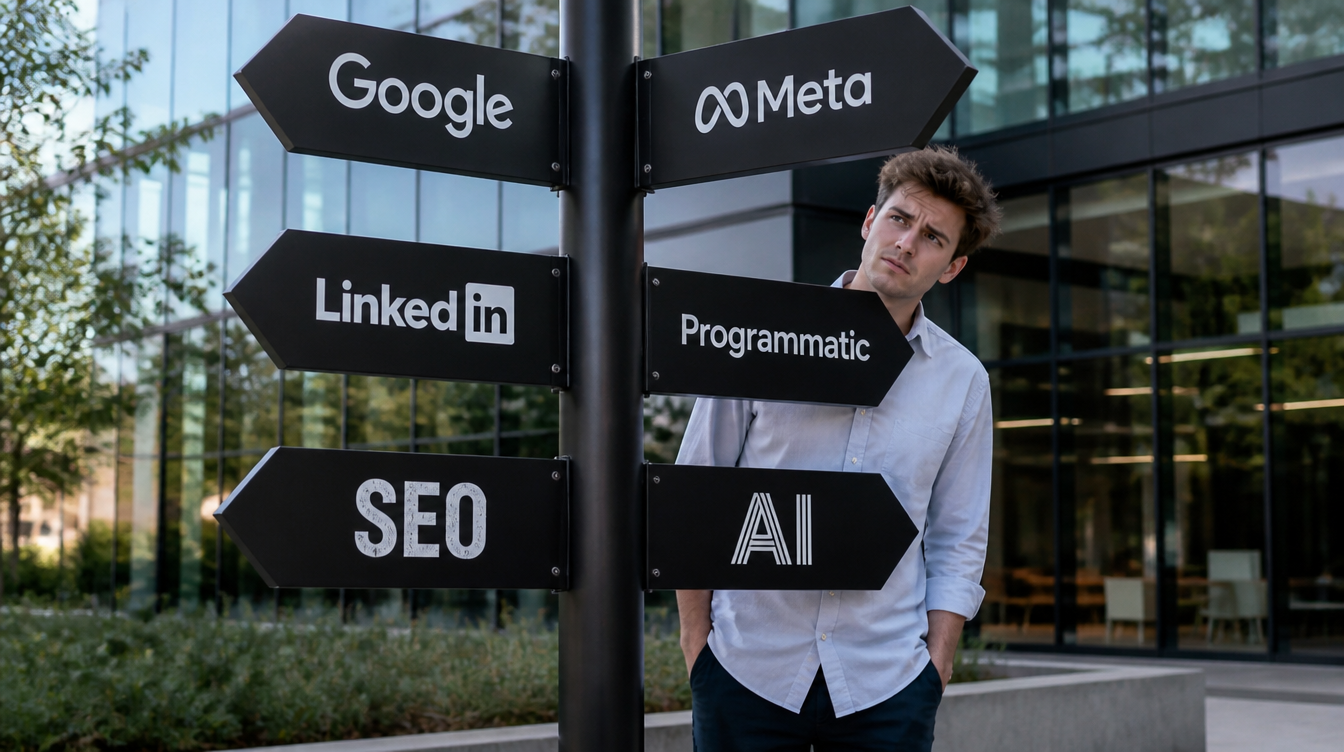
It is quite easy to start a paid media discussion in the wrong place. A business knows roughly who it wants to reach, somebody identifies the relevant channels, and before long the conversation is about Google versus LinkedIn, campaign structure, targeting and budget. All are important, but they can be secondary to a more basic question: is this an audience that it makes commercial sense to pay to acquire?
That distinction is often skipped, because a clearly defined audience is not necessarily a good paid media audience. The potential customers might be too few, too expensive to reach, worth too little when they convert, or some combination of all three.
Working backwards through the numbers
Take a hypothetical specialist training company. It sells a £300 professional course aimed at people working in a particular technical role. The target market is easy enough to describe and there are obvious ways to reach it through search and LinkedIn, so at first glance it looks like a good paid acquisition opportunity. The problem appears when you start working backwards.
After delivery costs, tutor fees and administration, perhaps the business makes £150 gross profit from each booking. It cannot sensibly spend all of that acquiring the customer, so let’s say it settles on £50. That figure is a decision rather than a given. It reflects how quickly the business needs to recover the cost, what net margin it expects to keep, and whether it is funding growth or taking profit. A company with patient capital and an established repeat purchase record might justify considerably more, while one that needs the cash back within the quarter will accept less. The acceptable number also varies enormously by sector. Customer acquisition cost in financial services, for example, can be much higher than in low-value ecommerce because the lifetime value of a mortgage, savings customer or investment relationship may justify substantially more upfront acquisition spend.
From there the chain is straightforward. If one in five enquiries becomes a booking, the company can afford to pay about £10 for a genuine sales enquiry. If its website turns 2% of paid visitors into enquiries, it can therefore afford roughly 20p for each visitor. Unfortunately, the relevant search traffic costs £3 or £4 per click and LinkedIn is more expensive still. That does not mean either platform is performing badly. It just means the numbers do not currently fit together.
This is why we tend to start with acquisition economics rather than media budgets. The important numbers are usually customer value, gross margin, conversion rate, sales conversion rate and the realistic cost of reaching the audience. They do not have to be perfectly accurate, and in many businesses they will not be, but even a rough model is useful because it tells you what has to be true for paid acquisition to work. It also stops us asking advertising to solve problems that sit elsewhere in the business.
What the model can and cannot fix
In the training example there are obvious ways to improve the picture. The company could increase its website conversion rate, or follow up enquiries better so that more of them become sales. It is worth noticing how little either does here. Double the website conversion rate and the affordable cost per click moves from 20p to 40p. Improve the enquiry handling as well and it might reach 60p. The traffic costs fifteen to twenty times what we can afford, so at this distance the familiar optimisation levers are rounding errors.
What does move the number is changing what a customer is worth. Bundling courses together, introducing an annual membership, or selling training packages to employers rather than individual delegates all work on the value side of the equation rather than the efficiency side, and at this sort of distance that is the only side with enough in it.
That is also the fair case for spending more than the gross profit on a single sale appears to allow. Where repeat purchase is genuinely evidenced, affordable acquisition cost is a multiple of the gross profit on the first order, and plenty of businesses are quite right to plan on that basis. The important part is having evidence for that repeat purchase behaviour rather than assuming it will happen. What we should be wary of is a plan that depends on every improvement happening at once. If the forecast only works because conversion rate doubles, acquisition costs fall by half and every new customer buys three additional products later, the assumptions deserve more scrutiny than the advertising plan.
The size of the market
There is another constraint that is often overlooked: the size of the market itself. A specialist business may have a wonderfully precise definition of its ideal customer and still only have a few thousand realistic prospects. That can make paid targeting relatively straightforward, but it does not necessarily make it scalable. Once you have reached most of the available audience, spending more money does not cause more suitable customers to appear. Frequency rises, targeting gets broader, and the next tranche of conversions tends to become more expensive.
This is especially important in niche B2B markets, but the same principle applies elsewhere. A local service business, a specialist software product or a high-value consultancy may all have quite limited pools of genuinely plausible customers. In those situations, paid media can still play a useful role without being the main growth engine: supporting an account-based sales programme, remarketing to known prospects or capturing high-intent searches. This is also where the choice between paid and organic acquisition strategies matters. In a small or specialist market, organic search, partnerships, events and direct outreach may be more efficient ways to build demand than repeatedly paying to reach the same limited audience. The mistake is assuming that because a platform allows us to target an audience, buying access to that audience must be the best way to grow.
What the platforms report
It is also worth being careful about the conversion numbers reported by advertising platforms. A £20 lead sounds inexpensive in isolation. If only one in 50 of those leads eventually buys, however, the effective media cost of acquiring a customer is £1,000. The same applies to app installs, registrations, downloads, demo requests and other intermediate conversions. They are useful measurements, but they only have commercial meaning when we understand their relationship with revenue.
A rough model is usually enough
A rough model is usually enough to answer the question “is paid media worth it?”
- What is a customer worth?
- What can we afford to spend acquiring one?
- How many enquiries, trials or other intermediate actions does it take to produce a customer?
- How much traffic do we therefore need, and what is that traffic likely to cost?
- Then there is one final question: are there enough potential customers to make the exercise worthwhile?
Sometimes the answer suggests an aggressive paid media strategy. Sometimes it suggests testing carefully and seeing whether the real-world numbers improve on the model. And occasionally it suggests that the media budget would be better spent somewhere else.
That is not a failure of paid media. It’s just the result of treating advertising as a commercial decision rather than an obligation.